Tom Horn
This post is a part of our series on Tom Horn – full collection of links at the bottom of the page.
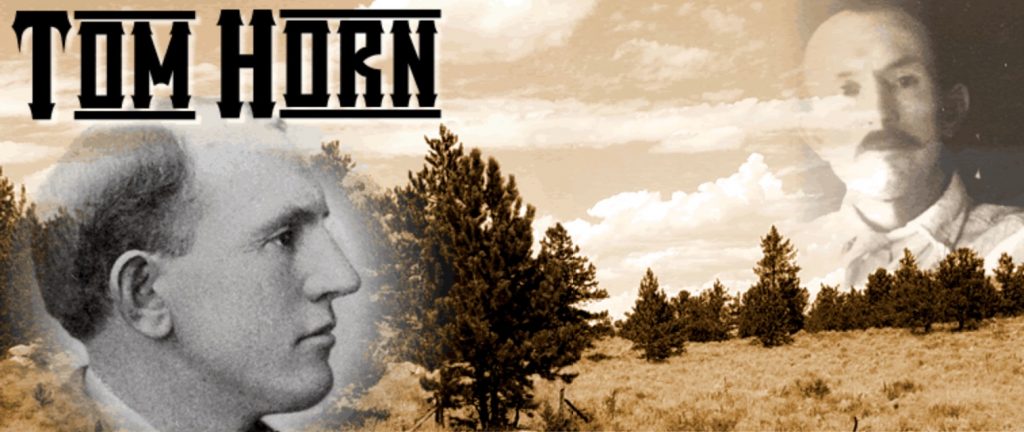
“Innocent!”
The word rang out like a gunshot in the crowded Cheyenne courtroom in September 1993, almost a hundred years after Tom Horn’s hanging for first-degree murder.
New Findings in the Tom Horn-Willie Nickell Murder Mystery
By Chip Carlson
© Copyright Chip Carlson
Although the 1901 murder of 14-year-old Willie Nickell was supposedly settled with the hanging of stock detective Tom Horn in 1903, new evidence and a recently discovered rifle open questions and add deepening mystery to the episode.
Was there more than one assassin?
A forensic firearms expert, Lucien Haag of Carefree, Arizona has used computer technology to develop graphics showing the wound paths in the body of young Nickell. Although the evidence is preliminary, it is possible that two shooters fired.
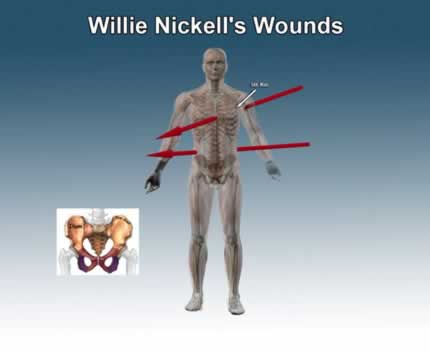
Haag used doctors’ testimony from the autopsy and trial testimony to chart the wound paths. However, without access to the boy’s clothing (which was lost to history) to corroborate whether there were two assassins, this remains only a theory.
Willie Nickell’s father stated that on the morning of the murder he and a surveyor were working northeast of Nickell’s Iron Mountain homestead when they heard three gunshots to the west – two in quick succession, followed by a third. The time lapse between the shots was never indicated.
Willie had ridden his father’s horse to the gate at the west perimeter of the property, dismounted to open the gate and lead the horse through, and turned to close the gate. Two shots hit him on the left back and side, traveled through his torso and exited. The boy ran or stumbled 20 yards toward home, and fell face-down. A younger brother found Willie the next morning. The body had gravel and dirt on the front with considerable blood, but had been turned over with the shirt torn open, perhaps by the killer(s) to verify who it was and view the wounds.
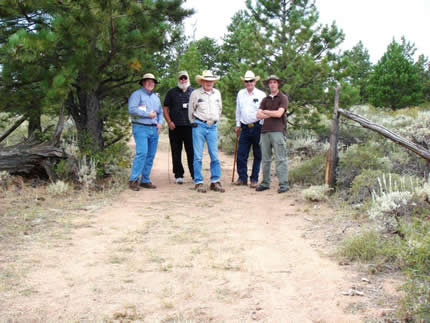
Haag visited the site of the murder with four local guides familiar with the history, Cheyenne’s Chip Carlson, Don Patterson, and Ken Rolfsness along with the Wyoming State Crime Lab’s firearms examiner, Steve Norris. Carlson is an author and authority on the crime, Patterson is the former Cheyenne chief of police who spearheaded a crime site survey in 1992, Rolfsness has played a major role in the history, portraying Tom Horn in his retrial in Cheyenne in 1993.
Haag has emphasized that no final conclusions can be drawn from his analysis, because the clothing Willie wore when murdered has been lost to history. It was, however, used as evidence in Tom Horn’s trial. A forensic examination and testing of this shirt, should it ever be located, would answer the question as to caliber, bullet type and possibly even range of fire. The clothing was Willie’s own, refuting rumors that he was wearing his father’s.
The Nickell family had been in feuds with a neighboring family, the Jim Millers, whose father had sworn to avenge the death of a son he attributed to the inflammatory actions of Willie’s father. Miller had two older sons, and the men of both families had been in violent confrontations.
Which rifle was used in the crime?
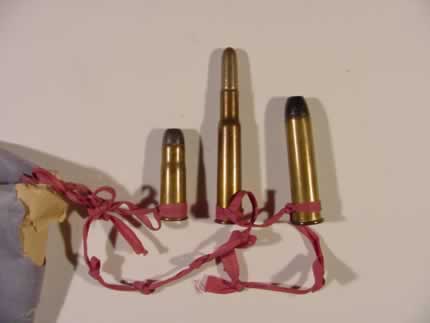
Tom Horn had a Winchester model 1894 .30-30 caliber in his possession when was arrested for the crime. However, there was a .45-60 cartridge in his pockets, along with a .30-40 Government cartridge and a .38-40 cartridge. These are now in the Wyoming State Museum’s collections. The cartridges may have been used in his trial although there is no written record of that.
A Winchester 76 model in .45-60 caliber has recently surfaced that came from the Bosler ranch of John Coble, Tom Horn’s chief benefactor. Now in private hands, it was acquired by the owner’s father from a Laramie County museum. The rifle has a crude leather sling with “John C. Coble, Bosler, WY” carved on it.
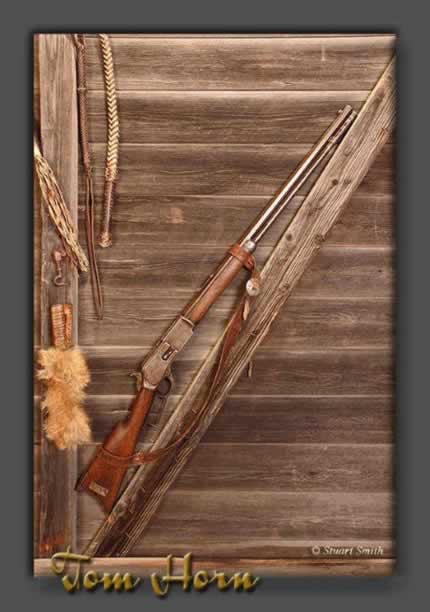
In the buttstock, wrapped around the sectioned cleaning rod was an envelope of the Wyoming Stock Growers Association upon which, written in pencil, are the lyrics to “Life’s Railroad to Heaven” (the hymn sung at Horn’s hanging) and signed G.M. Kimmell.
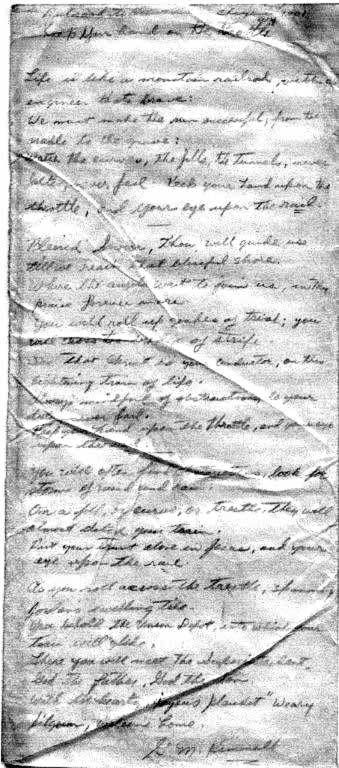
Glendolene Myrtle Kimmell was a school teacher at Iron Mountain. She boarded at the Miller ranch and was romantically linked in legend to Tom Horn. After his death she worked in Denver, editing his autobiography. The book was published by John Coble in 1904.
Accompanying the .45-60 rifle is a portion of Montana Standard newspaper (Butte, MT) dated May 9, 1937 that shows a picture of the Coble Ranch and has a number of handwritten and typewritten entries on it purportedly relating to the sale and transfer of this rifle. These have attached a Bill of Sale dated July 6, 1936 for $26 “One of 2 Winchester rifles from the Coble ranch, Jack Linscott.”
Linscott was a rancher in northern Albany County. Tom Horn stated that he was at Linscott’s place when Willie Nickell’s father was shot and wounded a few days after Willie’s murder.
In the Steve McQueen movie “Tom Horn,” McQueen stated that he preferred a .45-60 because it was easy to buy ammunition for it in any country store. McQueen’s movie researchers had combed the State Museum and apparently decided to reference that caliber because of the cartridges there.
The doctors who conducted Willie Nickell’s autopsy stated that the wounds were too large to have been made by a .30-caliber weapon.
Could Tom Horn – or someone else – have used a .45-60 in the Nickell murder, stashing it away for later retrieval?
This essay was originally published on Chip Carlson’s personal website, which has since expired, and is re-published here as a way to preserve some of the content of this historical figure. If you would like to continue learning about Tom Horn, please explore the links below. If you’d like to read the complete story, and help to support the author, his book can be purchased here.
More about Tom Horn:
Tom Horn (main page)
The Tom Horn Story (summary)
